
Firstly, we have hydroelectricity where electricity is generated by hydropower.
It is the production of electrical power through the use of the gravitational force of falling or flowing water. It is the most widely used form of renewable energy. Once a hydroelectric complex is constructed, the project produces no direct waste, and has a considerably lower output level of the greenhouse gas carbon dioxide (CO2) than fossil fuel powered energy plants. Worldwide, an installed capacity of 777 GWe supplied 2998 TWh of hydroelectricity in 2006. This was approximately 20% of the world's electricity, and accounted for about 88% of electricity from renewable sources.
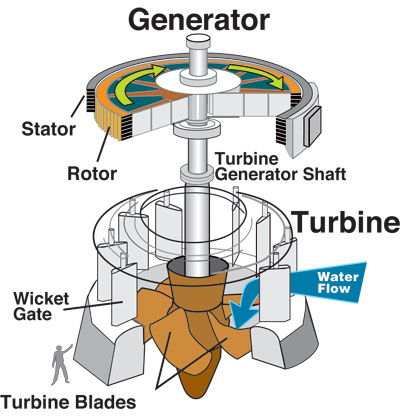
Most hydroelectric power comes from the potential energy of dammed water driving a water turbine and generator. In this case the energy extracted from the water depends on the volume and on the difference in height between the source and the water's outflow. This height difference is called the head. The amount of potential energy in water is proportional to the head. To deliver water to a turbine while maintaining pressure arising from the head, a large pipe called a penstock may be used.
Pumped storage hydroelectricity produces electricity to supply high peak demands by moving water between reservoirs at different elevations. At times of low electrical demand, excess generation capacity is used to pump water into the higher reservoir. When there is higher demand, water is released back into the lower reservoir through a turbine. Pumped storage schemes currently provide the only commercially important means of large-scale grid energy storage and improve the daily capacity factor of the generation system. Hydroelectric plants with no reservoir capacity are called run-of-the-river plants, since it is not then possible to store water. A tidal power plant makes use of the daily rise and fall of water due to tides; such sources are highly predictable, and if conditions permit construction of reservoirs, can also be dispatchable to generate power during high demand periods. Less common types of hydro schemes use water's kinetic energy or undammed sources such as undershot waterwheels.

Next, we can also generate electricity by burning fossil fuels.
A fossil-fuel power station is a power station that burns fossil fuels such as coal, natural gas or petroleum (oil) to produce electricity.
Fossil-fuel power station are designed on a large scale for continuous operation. In many countries, such plants provide most of the electrical energy used.Fossil fuel power stations (except for MHD generators) have some kind of rotating machinery to convert the heat energy of combustion into mechanical energy, which then operate an electrical generator. The prime mover may be a steam turbine, a gas turbine or, in small isolated plants, a reciprocating internal combustion engine. Some thermal plants have the intermediate step of using the heat from combustion to produce steam, reducing overall efficiency of electricity production. All plants use the drop between the high pressure and temperature of the steam or com busting fuel and the lower pressure of the atmosphere or condensing vapour in the steam turbine.
Byproducts of power thermal plant operation need to be considered in both the design and operation. Sometimes waste heat due to the finite efficiency of the power cycle, when not recovered and sold as steam or hot water, must be released to the atmosphere, often using a cooling tower, or river or lake water as a cooling medium, especially for condensing steam. The flue gas from combustion of the fossil fuels is discharged to the air; this contains carbon dioxide and water vapour, as well as other substances such as nitrogen, nitrogen oxides, sulfur oxides, and (in the case of coal-fired plants) fly ash and mercury. Solid waste ash from coal-fired boilers must also be removed, although some coal ash can be recycled for building materials.
Fossil fueled power stations are major emitters of greenhouse gases (GHG) which according to the consensus of scientific organisations are a major contributor to the global warming observed over the last 100 years. Brown coal emits 3 times as much GHG as natural gas, black coal emits twice as much. Efforts exist to use carbon capture and storage of emissions but these are not expected to be available on a commercial scale and economically viable basis by 2025

