
Meniscus (plural: menisci/meniscuses) is a curve in the surface of a molecular substance and is produced in response to the surface of the container or another object. It can be either concave or convex. A convex meniscus occurs when the molecules have a stronger attraction to each other than to the container. This may be seen between mercury and glass in barometers. Conversely, a concave meniscus occurs when the molecules of the liquid attract those of the container. This can be seen between water and an unfilled glass. One can over-fill a glass with water, producing a convex meniscus that raises above the top of the glass, due
to surface tension.
Capillary action acts on concave menisci to pull the liquid up, increasing the amount of energetically favorable contact area between liquid and container, and on convex menisci to pull the liquid down, reducing the amount of contact area. This phenomenon is important in transpirational pull in plants. Honey, water, milk etc. have a lower meniscus. When a tube of a narrow bore, often called a capillary tube, is dipped into a liquid and the liquid “wets” the tube (with zero contact angle), the liquid surface inside the tube forms a concave meniscus, which is a virtually spherical surface having the same radius, r, as the inside of the tube. The tube experiences a downward force of magnitude 2πrdσ.
Convex and concave meniscus
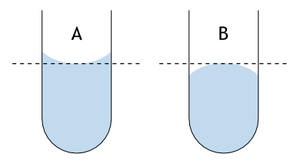
A: Concave Meniscus
B: Convex meniscus

Reference:
http://en.wikipedia.org/wiki/Meniscus
Done by: Kimberly Kiong
3/4/2010
